Javascript Execution Context Home
Learning From Miss Xing YouTube channel. JS Execution Context
What is Execution Context?
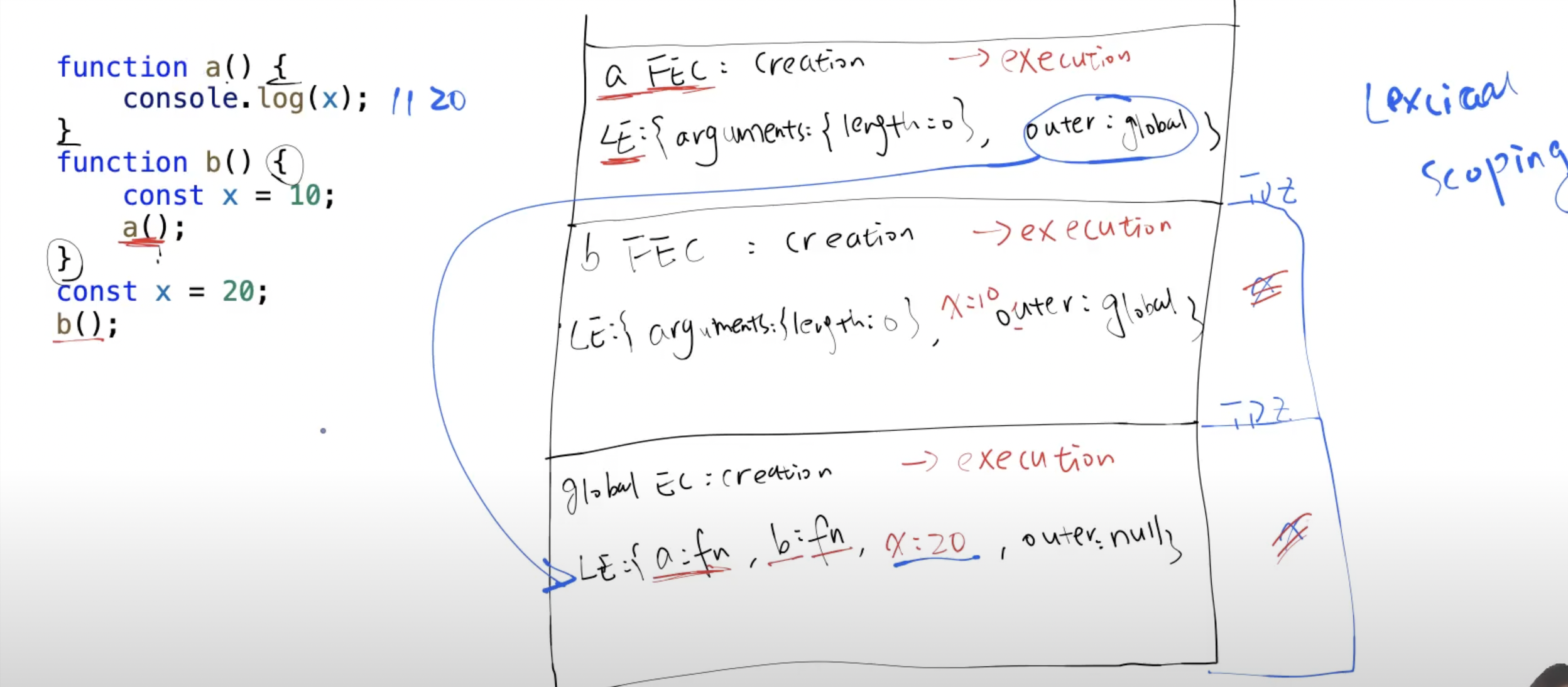
1. An Execution Context is created when javascript code is executed.
2. All Execution Context are pushed into Execution Context Stack.
Two Type of Execution Context
-
Global Execution Context(GEC)
- Default, loads first as the JS code executed.
- Only 1 Global EC for an application.
- Create a global object i.e. "window" object.
- this" keyword - global object: window.
-
Functional Execution Context(FEC)
- Created when function is called, each function has its own FEC.
- arguments object.
Execution Stack
* Also known as Calling stack, is a stack with LIFO structure.
* Used to store all Exection Context created during code execution.
* JS engine execute the function whose executioin context is at the top of the stack.
When this function is completed, its execution context is popped off from the stack,
and the control reaches to context below in it current stack.
Execution Context Stage
-
Creation Phase
-
JS Engine compile code, does not execute the code.
Records variable declarations, functions (only variable declared with keyword "var")
-
JS Engine compile code, does not execute the code.
-
Execution Phase
- Execute the code line by line.
- Update Variable values
- Execute the variable declared with "let" and "const"
During Creation/Execution Phase
var
1. Do I have any variable declared with "var"? skip those in function declaration but not in if, for, while code block. If "Yes" Put it in Lexical Environment with value undefined.
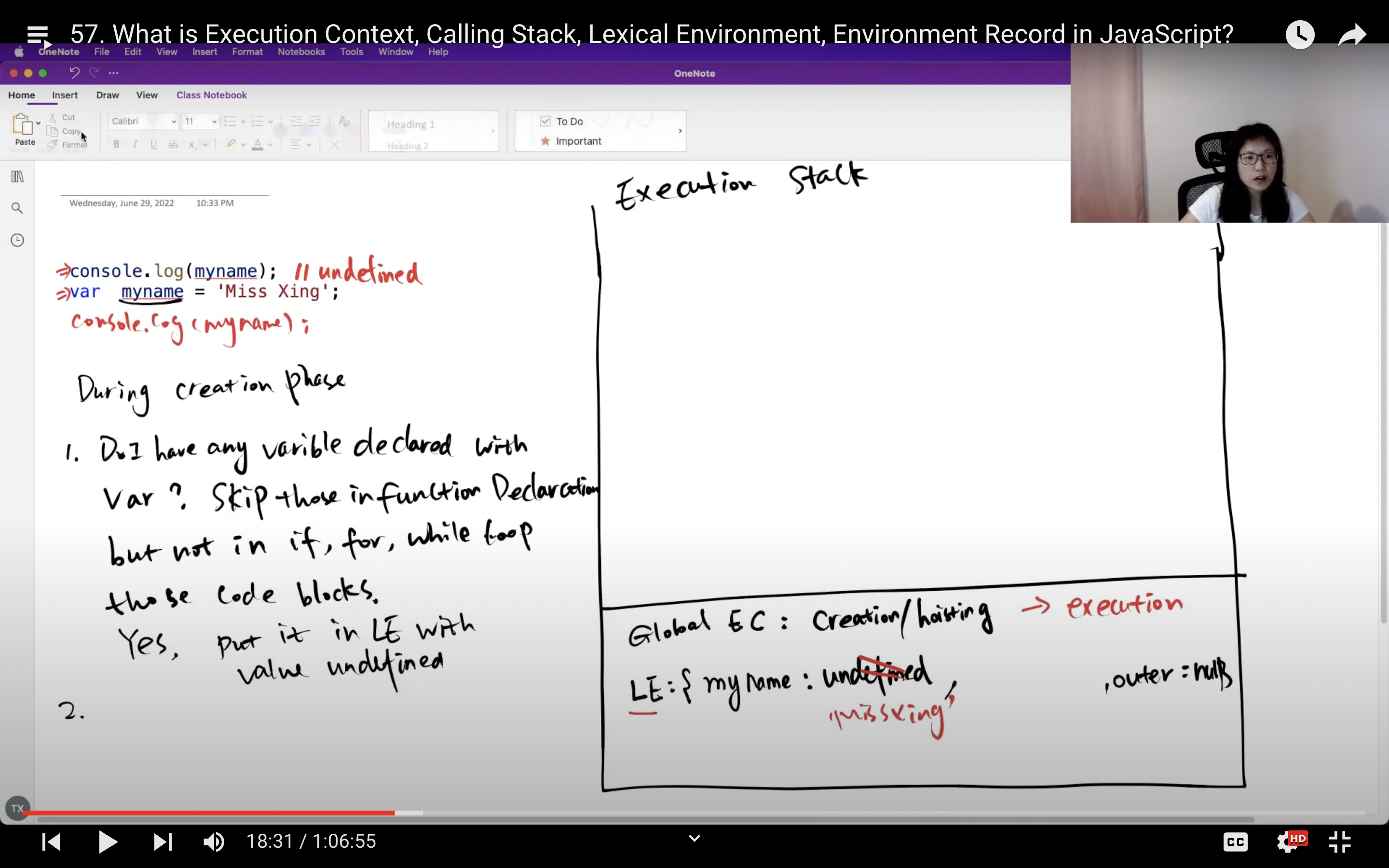
					console.log(myname); // undefined
					var myname = 'Sushil';
					console.log(myname); // Sushil
let
1. Do I have any variable declared with "let/const"? If Yes put them in Temporal Dead Zone.
						console.log(myname); // Uncaught ReferenceError: Cannot access 'myname' before initialization
						let myname = 'Sushil';
Code Block for var
Code Block(if, for, while) won't create scope for "var" variable except for "function"
						console.log(myname); // undefined
						if(true) {
							var myname = 'Sushil';
						}
						console.log(myname); // Sushil
Code Block for let
Code Block will create its own Execution stack and "let" variable scope remains within this stack only.
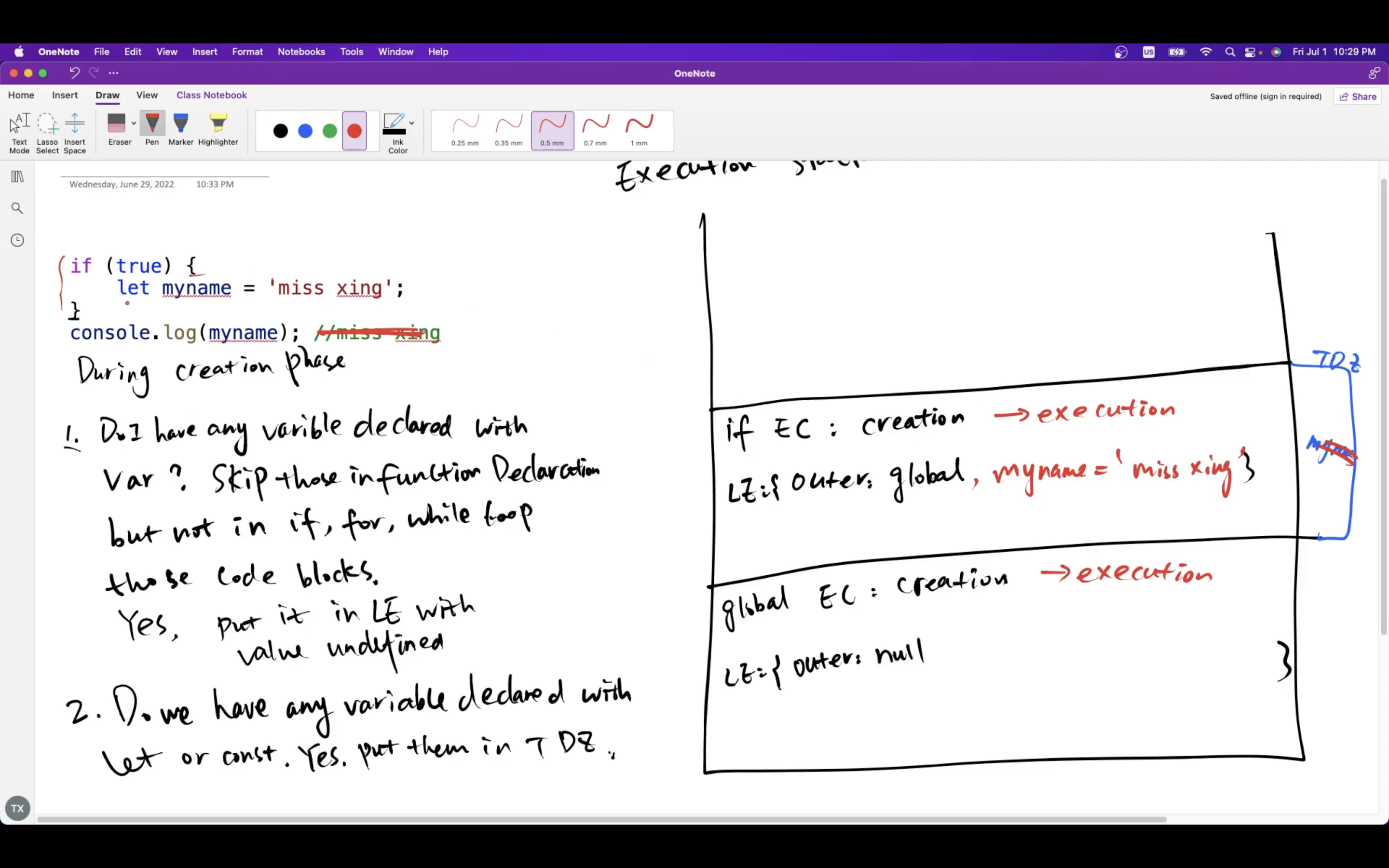
console.log(myname); // Uncaught ReferenceError: myname is not defined if(true) { let myname = 'Sushil'; }if(true) { let myname = 'Sushil'; } console.log(myname); // Uncaught ReferenceError: myname is not defined
function
var
						function foo(arg) {
							console.log(myname); // undefined
							if (arg) {
								var myname = "Sushil";
							}
							console.log(myname); // Sushil
						}

						foo(1);
						console.log(myname); // Uncaught ReferenceError: myname is not defined
let
						function foo(arg) {
							console.log(myname); // Uncaught ReferenceError: myname is not defined
							if (arg) {
								let myname = "Sushil";
								console.log(myname); // Sushil
							}
							console.log(myname); // Uncaught ReferenceError: myname is not defined
							myname is not found in this EC, so it will be looked in global EC if not found
							error is thrown
						}

						foo(1);
						console.log(myname); // Uncaught ReferenceError: myname is not defined
Function Declaration vs Function Expression
						foo(); // hello
						function foo() {
							console.log("hello")
						}
						foo(); // Uncaught TypeError: foo is not a function
						var foo = function () {
							console.log("hello")
						}
Note: function foo is defined with "var", so at the time of creation phase in Excecution Context, its value is undefined.
And at the time of execution phase, code is read line by line and foo method is called which is undefined hence throws error.
						foo(); // Uncaught ReferenceError: Cannot access 'foo' before initialization
						let foo = function () {
							console.log("hello")
						}
Note: function defined with "let" or "const" will be placed in Temporal dead zone (TDZ).
And at the time of execution phase, code is read line by line and foo property is not found in Lexical Environment hence throws ReferenceError.
Lexical Scope